How to Choose the First Enterprise Automation Pilot
A weighted method for choosing an enterprise automation pilot that is valuable, testable, reversible, and ready for real operating data.

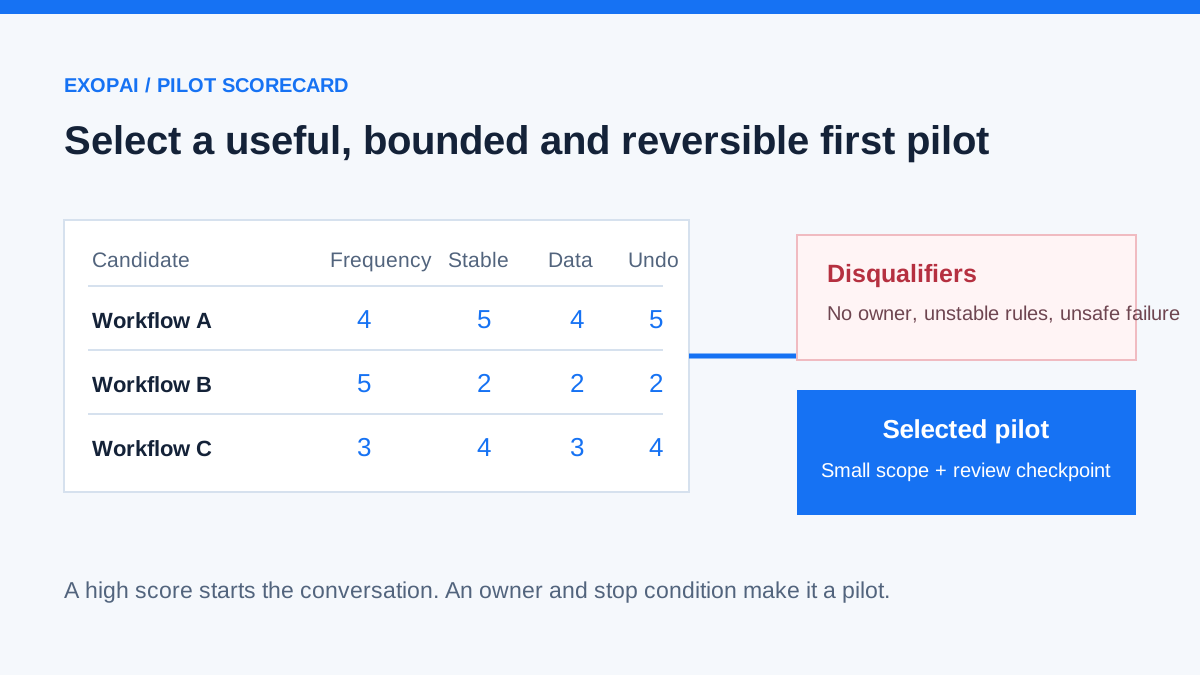
The best first enterprise automation pilot is not the biggest process or the one with the loudest sponsor. It is a frequent, bounded workflow with stable rules, accessible data, visible exceptions, and a failure mode the team can safely reverse. Choose it with a scorecard, then apply disqualifiers that a high score cannot override.
Define what the first pilot must prove
A first pilot should answer a small number of operational questions: Can the workflow complete the intended task with acceptable quality? Can people review exceptions without creating a second bottleneck? Can the company measure cost, time, and risk against a baseline? It does not need to prove that every department should adopt AI.
NIST's AI Risk Management Framework recommends mapping the context, affected roles, expected benefits, costs, and oversight before measuring and managing risk. That is a useful frame for pilot selection because it forces the team to name who owns the outcome and what could go wrong. Review the NIST AI Risk Management Framework before a system can influence sensitive or consequential work.
Score each candidate on five factors
1. Frequency and workload
Favor work that occurs often enough to produce evidence during the pilot. A quarterly process may matter, but it will take too long to learn from. Record case volume, handling time, waiting time, and seasonality rather than relying on impressions.
2. Rule stability
Look for a repeatable path with known decision criteria. A process that changes every week will make it difficult to tell whether failures come from the automation or the policy. Stable does not mean exception-free. It means the team can describe normal handling and name the exceptions.
3. Exception rate and ownership
A moderate exception rate can be healthy if each type has an owner and a clear response. Avoid a first pilot where most cases require undocumented judgment. The agent should know when to stop, what evidence to present, and who can decide.
4. Data and system access
Confirm that the required fields exist, are reliable, and can be accessed with appropriate permissions. A promising workflow can stall for months if the pilot depends on an unavailable integration or inconsistent identifiers. Test the data path before approving the business case.
5. Reversibility
The team needs a safe fallback. Prefer a pilot that can create a draft, recommendation, or review task before it performs an irreversible action. Human intervention at decision points is also part of Microsoft's guidance for reliable automation, alongside tight scope and measurable return.
Use disqualifiers after scoring
A weighted score helps compare candidates, but it cannot make an unsafe process suitable. Disqualify a workflow if no accountable owner exists, the failure could cause unacceptable harm, required data cannot be used lawfully, controls cannot be audited, or the process is about to be replaced. A large potential saving does not cancel those conditions.
Then check the economics with a complete baseline. EXOPAI's guide to measuring AI automation ROI beyond hours saved explains how to separate capacity, cash savings, quality, implementation cost, and ongoing oversight.
A weighted example
Illustrative scenario, not an EXOPAI client result: A company compares invoice intake, contract review, and internal access requests. It weights frequency at 25 percent, rule stability at 20 percent, exception ownership at 20 percent, data readiness at 20 percent, and reversibility at 15 percent. Access requests score highest because the rules and owners are clear, but the security team finds that one system cannot yet provide a reliable audit log. The team narrows the pilot to low-risk application access where approvals and rollback already exist.
The scorecard did not select a tool. It selected a testable slice of work. The final pilot brief names the start and end event, eligible cases, excluded cases, owner, reviewer, fallback, data sources, permissions, and stop conditions.
Set the baseline before building
Measure current volume, median completion time, waiting time, error and rework rates, and human effort. Sample enough cases to include normal exceptions. Decide what improvement would justify expansion and what result would stop the pilot. Keep quality and risk measures beside speed and cost so the team cannot claim success by moving errors downstream.
Run a small pilot with a real review queue
Start with one team, one workflow version, and a defined time window. Let the system prepare or complete only the approved steps. Route uncertain cases to a visible queue and log the reason, evidence, response, and final outcome. Review failures weekly. If most exceptions share one cause, improve the process or data before widening the scope.
A first pilot earns the right to expand when the result is repeatable, the controls work under pressure, and the operating owner wants to keep it. It should not expand because a demo looked smooth.
Conclusion
Choose the first automation pilot for learning quality, not presentation value. Score frequent and stable workflows, verify data access, require named exception owners, and reject candidates with unsafe or irreversible failure modes. If you want a neutral review of your shortlist and a measurable pilot brief, talk with EXOPAI.


